

LLMs excel at generating language. But in long, multi-step reasoning, they reach a structural de-facto-limit, resulting from operating in the tokens representation space.
To move beyond this limitation, we introduce a production-grade model architecture with a dual-space approach. That second representation space adds structure and stability to reasoning — unlocking high-value usage scenarios that current model architectures are unable to deliver.
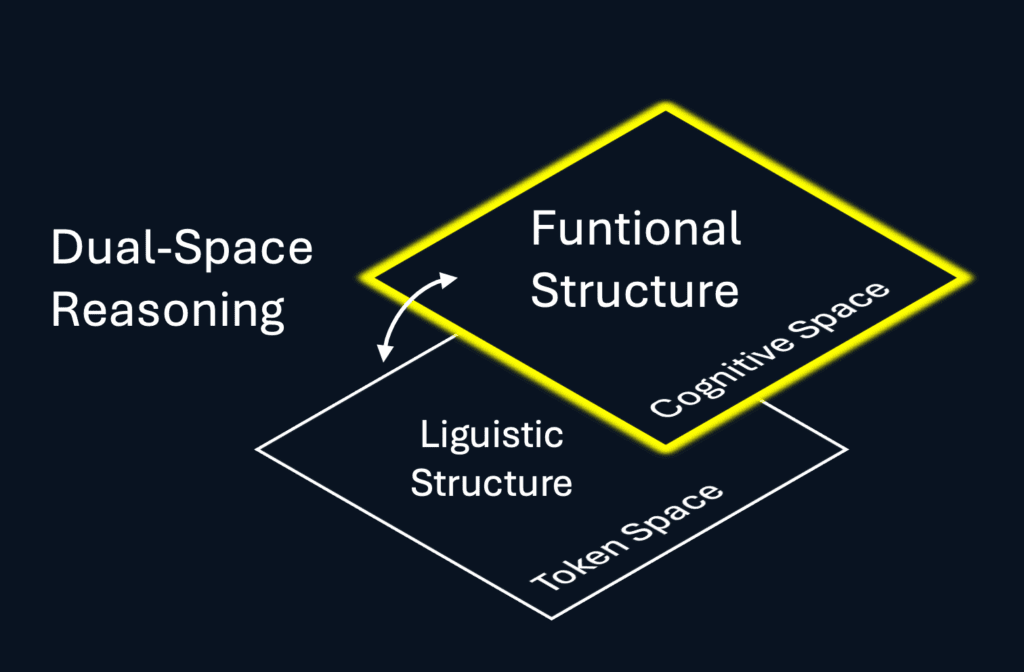
How they complement each other:The architecture relies on a bidirectional coupling. The Token Space provides the expressive power to generate hypotheses, while the Functional Space provides the structural skeleton to validate and organize them.
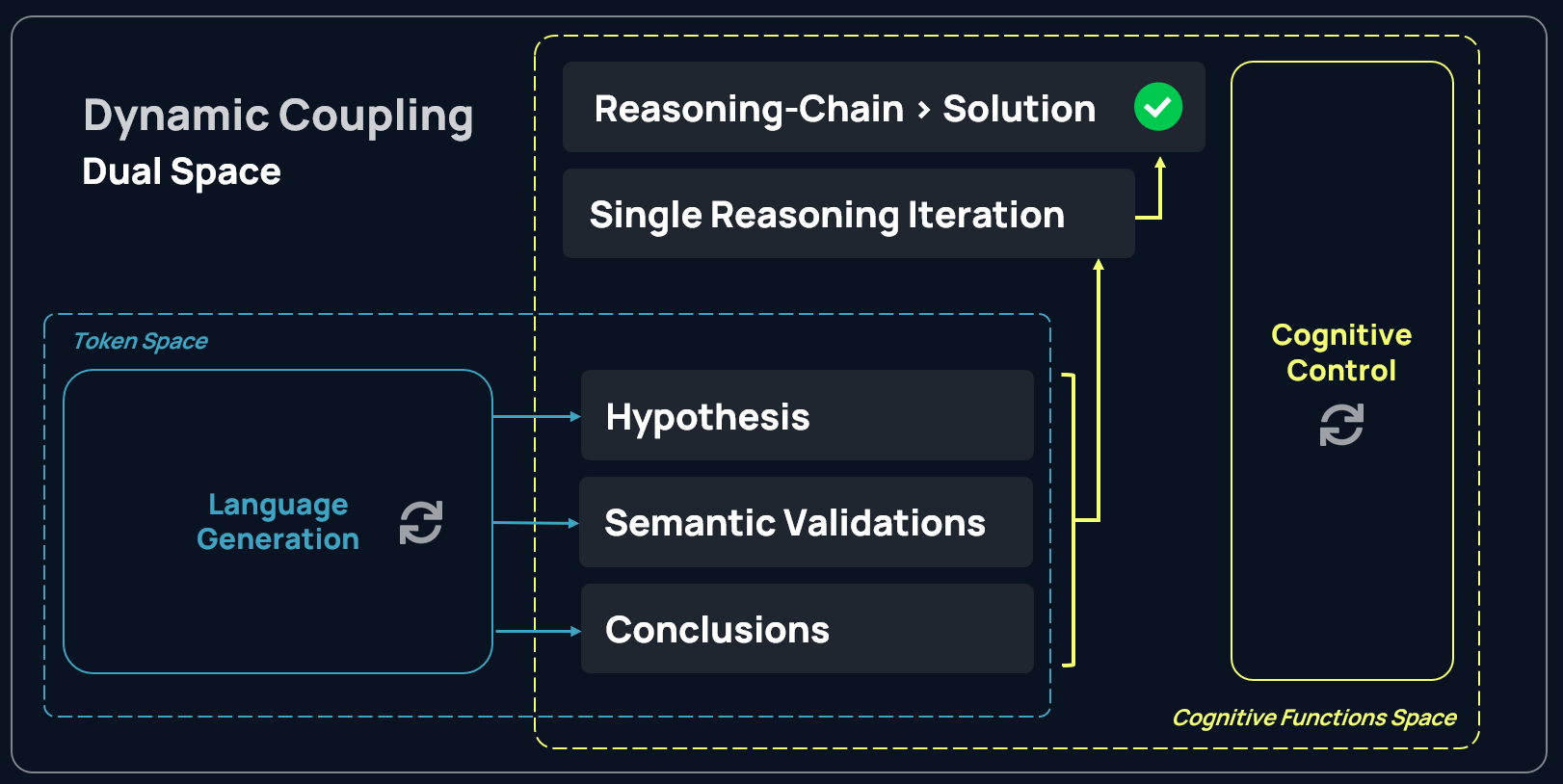
In a Dual-Space system, the Token Space and the Cognitive Functions Space follow different dynamics. The Token Space operates with the linguistic surface, while the Cognitive Functions Space manages and maintains the functional concistency of the reasoning chain.
Because these two layers evolve according to different principles, they need Dynamic Coupling in an abstract sense: language may explore alternative phrasings or branches, while the functional layer must maintain a coherent, well-structured Reasoning-Chain. Without an explicit coordination mechanism, this drift accumulates rapidly — especially in long, multi-step reasoning.
Cognitive Control prevents this divergence by synchronizing both layers at every step. It continuously aligns linguistic surface with functional purpose, ensuring that the expression of a thought and the cognitive role it fulfills remain tightly coupled. The result is a consistent Reasoning-Chain in which Hypotheses, Validations and Conclusions move forward together — coherent, stable, and logically anchored.
Textual surface and cognitive function are being kept in sync. That is the prerequisite for chaining. Valid functional sequences of such chains are defined in the Cognitive Schema, which describe common structural patterns in complex reasoning.
Reasoning requires coordination — otherwise linguistic variation can accumulate into drift. Cognitive Control progresses the chaining process, driven by the Cognitive Operators. It helps maintain meaningful progression and avoids transitions that would break the logical structure.
Cognitive Control preserves the expressive richness of the Token Space while maintaining structural integrity in the Functional Space. Language remains flexible and creative — yet every step stays logically anchored and stable.
Dynamic Coupling — Dual Space
In a Dual-Space system, the Token Space and the Cognitive Functions Space follow different dynamics: The Token Space shapes linguistic expression, while the Cognitive Functions Space maintains the structure of the reasoning path.
None of them can be seen alone, they must be handled as an integrated „thing“.
As reasoning chains grow in size and complexity, Cognitive Control provides the stabilization for longer reasoning chains, that the token space alone cannot realistically deliver, beyond a certain point.
This is where AI unlocks a new dimension.
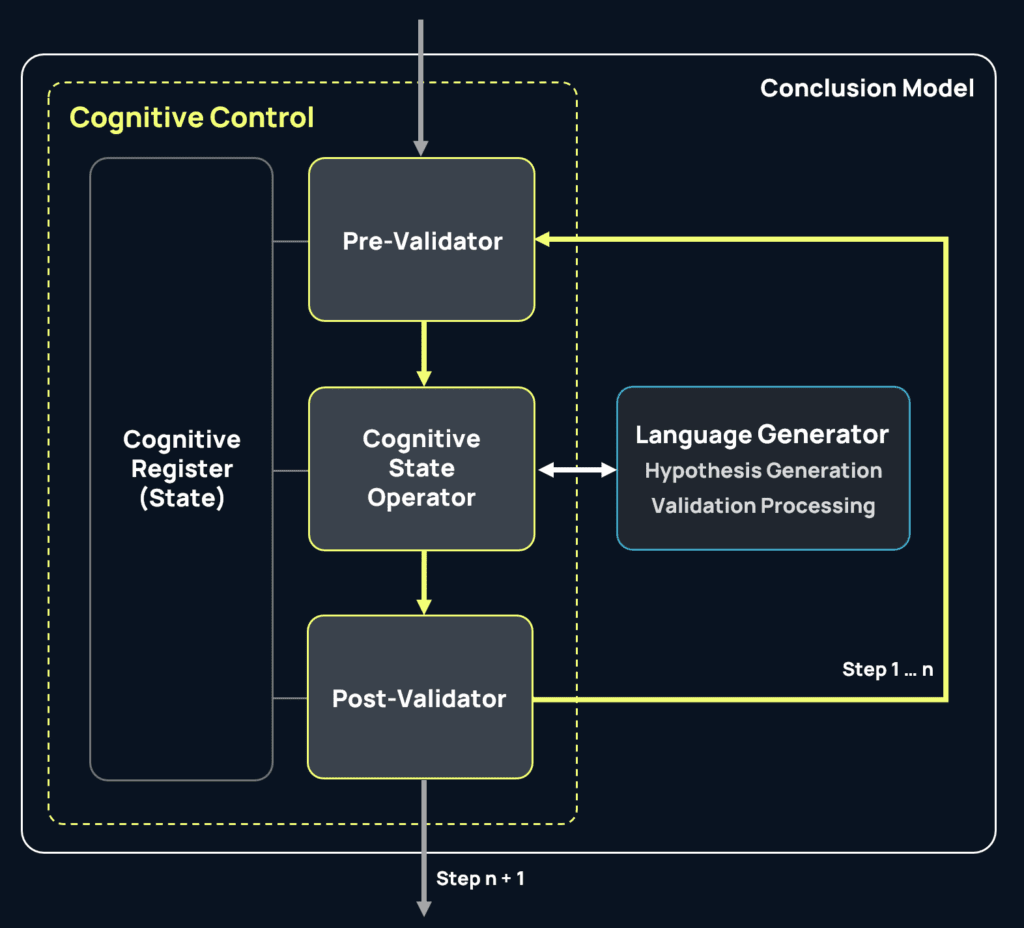
In-Situ Alignment
Each reasoning step is assessed inside the functional space — not only at the end. This helps prevent inconsistencies from accumulating as the chain unfolds..
Pre- & Post-Validation
Validations are applied through Cognitive Verification Operators, paired with the thought being examined. Some more text Some more text Some more text Some more text Some more text…
Self-Correction by Design
If a step doesn’t meet the required criteria, the system guides the reasoning back toward a coherent path, prompting refinement in the Token Space. This creates a reasoning chain that is stable by design — not by chance.
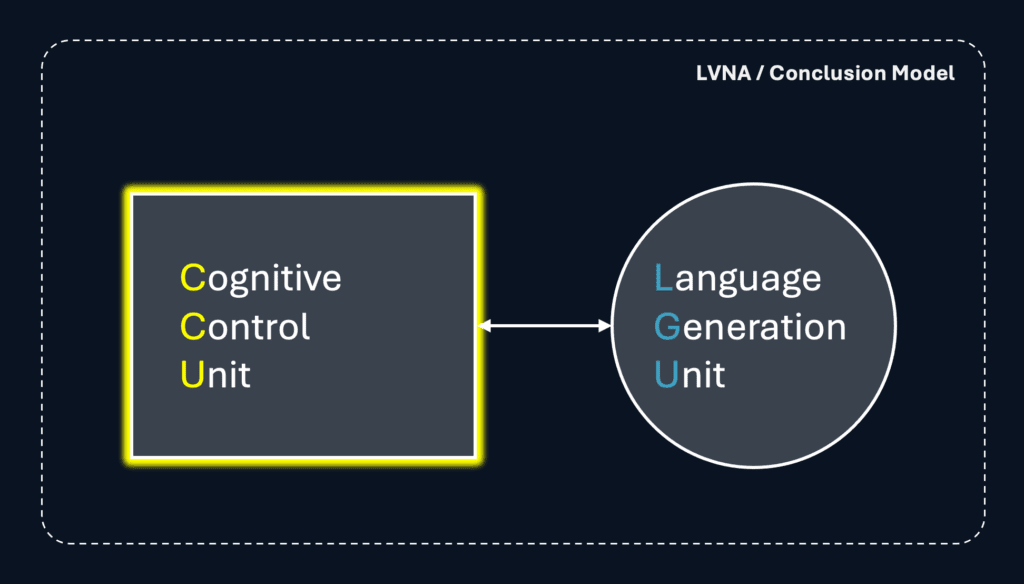
LVNA is the specific system design that brings the two spaces — language and cognition — into a single, coherent model architecture.
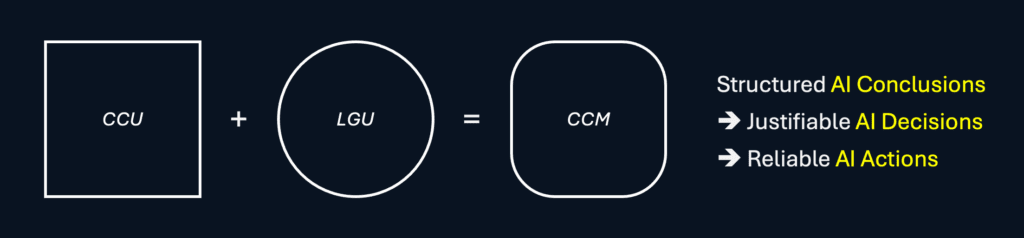
Inside this setup, the creative strengths of the Language Generation Unit work in harmony with the Cognitive Control Unit. Together, they provide the foundation for Cognitive Conclusion Models.
LVNA is the architectural blueprint for building real-world CCMs — so that those CCMs can do their job in delivering stable reasoning chains, opening the door to high-value use cases from a customers viewpoint.
As a customer, the LVNA pattern translates into:
– less error rates, resulting in less manual correction effort,
– full transparency, audit-safe,
– building human trust through transparency; to speed-up adoption.
Dual-Space Reasoning strukturiert Gedankenketten entlang funktionaler Einheiten.
Das stabilisiert komplexe Schlussfolgerungen — Schritt für Schritt, auch über lange Ketten hinweg.
Strukturiertes Schließen ist die Grundlage belastbarer KI-Entscheidungen. Und das wiederum die Grundlage zuverlässiger KI-Handlungen.
The Cognitive Control Unit is the structural center of the model. It guides how thoughts are organized and how cognitive operators interact. The result: expression and purpose move forward in sync.
Reasoning needs memory that lasts. The Cognitive Register provides a stable, inspectable record of the model’s thought process — a clear view of how conclusions take shape.
LVNA strengthens reliability at scale. By separating the reasoning structure from surface generation, it enables clearer inspection and consistent operational stability — something traditional token-only models struggle to maintain.
High–Value AI. For High-Value Business.
A New Layer of Reasoning
CCMs continue to use LLMs for expression — but they no longer rely on them to carry the full weight of reasoning. LVNA removes that burden from the probabilistic Token Space.
High-Value meets High-Stake
In finance, engineering, legal contexts, or regulated environments, a plausible answer is not enough. CCMs provide the level of reproducibility, traceability, and auditability.
Production-Grade Stability
CCMs demonstrate that the structural limits of token-only reasoning can be overcome today — delivering robust, long-chain inference. A new level of AI Business Value. Ready to be unlocked.
